

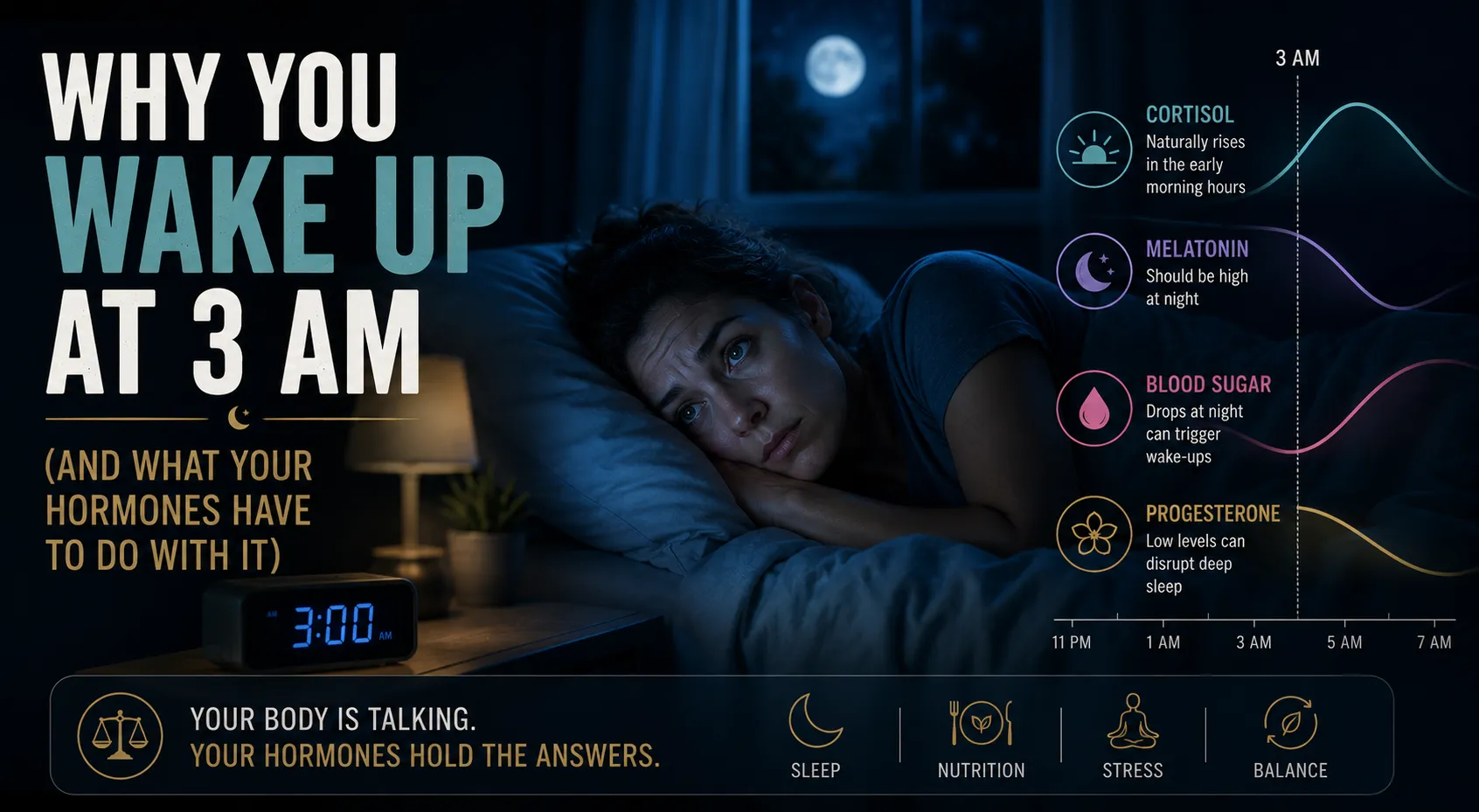
You fall asleep fine. No trouble there. But somewhere between 2 and 4 in the morning, your eyes open and your brain turns on like a switch you didn’t flip. You lie there, wide awake, running through tomorrow’s to-do list, replaying conversations, staring at the ceiling until the alarm goes off. Then you spend the rest of the day exhausted.
If this sounds familiar, you are not imagining it. And it is not a sleep problem. It is a hormone problem.
The Hormone Connection Most Doctors Miss
When patients bring up this middle-of-the-night waking pattern, most doctors hand them a sleep hygiene checklist. Avoid screens before bed. No caffeine after noon. Try melatonin.
These are not bad suggestions. But they do not address what is actually causing the problem in most cases: a hormonal shift that happens predictably as people age, and that is rarely tested for.
For women, the culprit is usually progesterone. Progesterone is a calming hormone. It binds to GABA receptors in the brain, the same receptors targeted by anti-anxiety medications, and produces a sedative effect that helps you stay asleep through the night. When progesterone declines, which happens gradually through perimenopause and then sharply after menopause, that calming effect disappears. The result is frequent waking, often between 2 and 4 AM, which is when progesterone’s overnight influence is most needed.
For men, the issue is more often testosterone. Testosterone plays a key role in the amount of REM sleep a person gets. As testosterone declines with age, REM sleep declines with it. Less REM means less restorative sleep, which means waking up feeling like the night did nothing for you even when you logged seven or eight hours.
Neither of these patterns will show up on a standard sleep study. Neither is addressed by a melatonin gummy.
What Cortisol Is Doing While You Sleep
The second hormonal layer in this picture is cortisol. Most people think of cortisol as a stress hormone, which is true. But cortisol also follows a precise daily rhythm. It should be lowest at night, allowing deep sleep, and then rise sharply in the early morning to wake you up naturally, alert and ready to move.
When that rhythm gets disrupted, which is extremely common in people under chronic stress, the pattern inverts. Cortisol runs high at night (preventing deep, restorative sleep), and runs low in the morning (making it nearly impossible to get out of bed). This is what providers call the “wired but tired” pattern. You cannot fall asleep easily, you wake frequently, and then you feel like a zombie for the first two hours of the day no matter how long you slept.
There are three recognizable stages to cortisol dysregulation. In the first stage, cortisol is simply elevated. The body is in a high-output stress state. Energy feels good, maybe even too good, and sleep is light and fragmented. In the second stage, which develops after prolonged stress, cortisol patterns become unpredictable. It may be low in the morning and high at night, the opposite of where it should be. In the third stage, the adrenal glands have been running in overdrive for so long that they can no longer produce adequate cortisol at all. This stage looks like deep fatigue, difficulty responding to any stress, and waking up exhausted regardless of sleep duration.
Standard blood cortisol tests, drawn at 8 AM, catch only a single snapshot. They miss the full picture. Salivary cortisol testing, drawn at four points across the day, maps the entire 24-hour curve and can identify exactly which stage someone is in and where the pattern breaks down.
The 4+ Cups of Coffee Problem
Here is a reliable sign that cortisol dysregulation is present: needing four or more cups of coffee just to feel functional.
Caffeine does not create energy. It blocks adenosine, the chemical signal that builds up in the brain and makes you feel tired. When cortisol is properly regulated, you wake up with natural energy and coffee is optional, a pleasure rather than a necessity. When cortisol is dysregulated, adenosine builds up faster than normal and coffee becomes the only thing standing between you and a completely non-functional morning.
The caffeine also has a direct effect on sleep. Caffeine’s half-life is around five to six hours. A cup of coffee at 2 PM still has meaningful caffeine activity at 7 or 8 PM. That matters a lot when you are already dealing with cortisol that is running too high in the evening hours.
Stopping caffeine intake by noon, or by 3 PM at the latest, is one of the most impactful changes a person can make when trying to restore natural sleep. It does not fix the underlying cortisol problem, but it removes one of the biggest obstacles to deep sleep while the root cause is being addressed.
Why Sleep Quality Matters More Than Sleep Quantity
There is a meaningful difference between sleeping eight hours and sleeping eight hours well. Deep sleep, the slow-wave stage, is not just rest. It is when the brain performs something extraordinary.
During deep sleep, cerebrospinal fluid flows through the brain in pulsing waves, flushing out metabolic waste products including beta-amyloid and tau proteins, the same proteins associated with Alzheimer’s disease. This cleaning process requires sustained deep sleep. It cannot happen efficiently in fragmented or shallow sleep.
The standard amount of time a person spends in deep sleep when fully rested is somewhere between 40 and 100 minutes per night, out of a full seven to eight hour night. If sleep is broken, if someone wakes multiple times, if hormonal disruption prevents full cycling through the sleep stages, that cleaning time gets cut dramatically.
The downstream effects go far beyond morning fatigue. Chronic sleep deprivation affects memory consolidation, emotional regulation, immune function, metabolic rate, and long-term brain health. None of that can be solved with a better mattress.
The Role of the Gut
One factor that rarely comes up in sleep conversations is the gut. Around 80 percent of serotonin, the neurotransmitter that regulates mood and also serves as the precursor to melatonin, is produced in the gut. Not in the brain. In the gut.
This means that gut health has a direct impact on the body’s ability to produce melatonin naturally. If gut bacteria are disrupted, which is common in people with poor sleep, high stress, or irregular eating patterns, serotonin production drops. Less serotonin means less melatonin. Less melatonin means difficulty falling asleep and staying asleep.
Supplemental melatonin can help temporarily, but it does not address the underlying production problem. And melatonin supplements are often dosed far higher than physiologically appropriate, which can actually suppress the body’s own production over time.
What Good Sleep Actually Requires
The body has specific conditions it needs to enter and maintain deep sleep. Temperature is one of the more underappreciated ones. Core body temperature needs to drop to initiate sleep, and the optimal sleep environment temperature is around 66 to 68 degrees Fahrenheit. Many people sleep too warm, which is one reason why people often sleep better with the window cracked in cooler months.
Blue light is another well-documented disruptor. Light, especially the short-wavelength blue light emitted by screens, signals the brain to suppress melatonin. This is a biological survival mechanism, not a lifestyle quirk. The brain interprets light as daytime. Exposure in the two hours before bed delays sleep onset and reduces deep sleep even when total sleep time looks adequate.
Alcohol is the other commonly misunderstood factor. Alcohol causes sedation, which people interpret as helping them fall asleep. But alcohol suppresses REM sleep and causes fragmentation in the second half of the night. The person who drinks two glasses of wine and sleeps eight hours often gets dramatically less restorative sleep than someone who slept seven hours without alcohol.
When Sleep Hygiene Is Not Enough
Sleep hygiene advice is not wrong. The problem is that it treats the symptom without addressing the cause.
If someone is waking at 3 AM because progesterone has declined, no amount of screen-time reduction will fix it. If cortisol is running in reverse, cutting caffeine helps but does not restore the rhythm. If testosterone has dropped enough to reduce REM sleep significantly, behavioral changes will produce marginal improvements at best.
Testing is the only way to know what is actually happening. A complete hormonal panel that includes progesterone, testosterone, DHEA, and thyroid markers, combined with a four-point salivary cortisol map, can identify exactly what is disrupting sleep and allow treatment to be targeted rather than generic.
Providers who work in this space have seen patients who have been on sleep medications for years who simply had low progesterone that nobody checked. They have seen people with cortisol rhythms so inverted that no behavioral intervention was going to work without first restoring the hormonal pattern. The testing does not take long. Getting there does not require a referral process that takes six months.
If you have been doing everything right and still waking at 3 AM, the answer is probably not in your nighttime routine. It is in your labs.
About the Author: This article was written by the clinical education team at Med Matrix, a functional medicine clinic in South Portland, Maine. Med Matrix serves over 3,000 patients with a provider team that specializes in root-cause testing, hormone optimization, and personalized treatment plans.